We use cookies to provide you with personalized services and improve our website. More info Ok
200 ms response time for maximised process performance and reliability
Nijhuis Saur Industries (NSI), part of Saur Group, introduced PFAS Resolve at IFAT 2026 in Munich. It is a Saur Group solution: a modular concept combining advanced technologies to address the full spectrum of PFAS contamination directly on site.
Yokogawa Electric Corporation announces that its OpreX™ Open Automation SI Kit for Open Process Automation™ (OPA) systems has been certified for conformance with the OPC Unified Architecture (OPC UA) profile of the Open Process Automation Standard (O‑PAS™), a first in the process industry.
A long-standing automation partnership between a Swiss machine builder and one of the world’s leading manufacturers of industrial robots is aiming to help transform the pharmaceutical supply chain in Europe with the launch of what is believed to be the ‘smallest’ automated palletising cell for vials and pre-filled syringes.
Qlar is opening a new Test Center for reliable pneumatic conveying in Bangalore, India, supporting customers in the metals, cement and energy sectors. With the facility, Qlar is strengthening its position as a provider of practical test infrastructure.
The fertilizer sector is caught in a global paradox between growing food to feed billions and the urgent need to decarbonise. Compressors present a largely overlooked opportunity to reduce lifecycle costs and carbon emissions, while enabling more sustainable production of ammonia. Author: Greg Gedney, Business Development Manager, Industrial Operations, Greene Tweed
Combination of laser and paramagnetic detection methods for a for a wide range of applications
For use in rugged applicactions from -40 to 75 °C
SOPAT and Parsum optical inline systems will further strengthen the process analysis portfolio. The Germany-based specialist in inline process measurement technology, retaining the company’s staff in Berlin and Chemnitz.
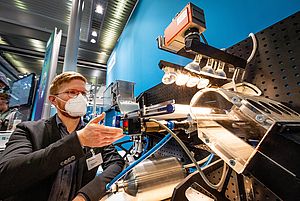
The latest trends in robotics can be experienced at HANNOVER MESSE 2026 from April 20 to 24.
Cost-effective alternative for applications without need for IP68 approval
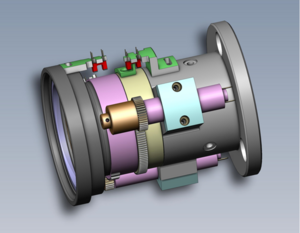
In response to the recent global shortage of Germanium, an essential material for optical components in long-wavelength infrared cameras, Optris has engineered and launched a new optical design that completely removes the need for Germanium. Germanium has long been the main material for lenses and windows in thermal imaging systems. However, issues like supply shortages, export restrictions,...
Hanna Lundin, product engineer at Emerson, explains in this article how simplified tank monitoring system architectures make it more feasible for companies to implement an automated solution to improve their inventory management, increase safety and efficiency.
APC enables capacity increases without new hardware, energy savings and cost reduction through continuous optimization, and more stable product quality under fluctuating conditions.
Inline Ultrasonic Concentration Measurement and Bubble Detection System
Increased safety through clarity in challenging situations for the process industry and railway sector
Ethernet-APL enables fast, standardized Ethernet communication down to field level, even in hazardous areas. While the technology simplifies engineering, commissioning, and diagnostics, the real value lies in integrated solutions. With engineered, certified systems tailored to customer needs, operators benefit from reduced complexity, faster deployment, and higher system availability.
The collaboration is paving the way for seamless MES deployment on HMI Systems in pharma and biotechnology
Stainless-steel motors for the food industry
Precise material analysis plays a central role in many industries - from the pharmaceutical and food industries to construction materials, biotechnology and environmental sciences. Whether for quality assurance or for predicting material behaviour, the precise characterisation of particles is crucial.
The goal of the alliance of the companies Bizerba, FANUC, KILIVATIONS and Schmalz, announced at automatica 2025, is to drive the development and implementation of forward-looking automation solutions in a practical, innovative and customer-centric way
Reliable measurements of strongly fluctuating levels
Agriculture is facing major challenges today. Climate change, increasing demands on sustainability and the pressure to achieve higher yields with lower resource consumption require innovative solutions. Greenhouses offer a controllable environment that can be made even more efficient through technological advances such as the Industrial Internet of Things (IIoT).
Integration of OPC UA with Allotrope Standards for seamlessly interoperable communications and information data in analytical labs
Additional 4,000 square meters of production and warehouse facilites for efficient manufacturing processes
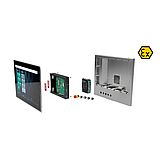
Pepperl+Fuchs Integrates RFID Reader Into VisuNet GXP HMI Platform and Enables Authentication up to Zone 1/21
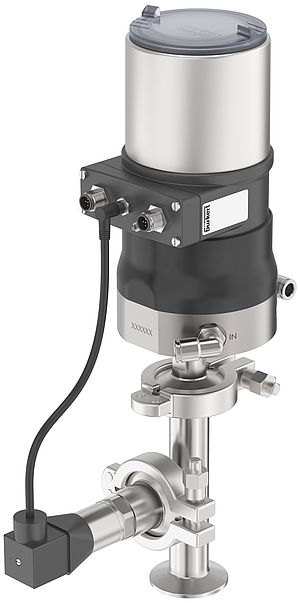
Integrated drift detection for highest process reliability
The HIMA Group proudly marked a significant milestone: the 50th anniversary of Sella Controls. On October 9, 2024, a safety symposium was held in Birmingham to commemorate this achievement, honouring Sella Controls' journey from its modest beginnings in Whaley Bridge to its status as a leader in safety and control systems, now part of the HIMA Group.
Plasma-coated paper as a plastic alternative for the packaging industry
Innovative concept with particularly high volumetric flow rates that are virtually identical in all directions
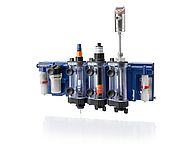
Clean water for rearing healthy fish – High-performance systems for sustainable production in RAS
Unique optical module fits for a wide range of mounting arrangements used by different satellite camera systems
High precision measurements despite high temperatures
Digital Twin Platform in Conjunction with Digital Nameplates for the Process Industry Introduced at ACHEMA
Minimising downtimes with predictive maintenance
Optimised solution for a surveillance camera manufacturer
Today, the majority of consumer goods and everyday items are made from petroleum-based plastics. In Germany alone, around six million tonnes of plastic waste is generated every year. About half of this is mechanically recycled into new materials; the rest is used for energy recovery. The incineration of this waste results in the release of CO2, a greenhouse gas. It is therefore important to keep more plastics in the material cycle for climate and environmental reasons. Eight Fraunhofer Institutes are developing new ideas and processes to significantly improve the mechanical recycling rate of plastics as part of the Waste4Future flagship project.
Methane emission regulations and reduction targets such as “Fit for 55” transform the technology used for pipeline shutdown
Under the heading "Forging Tomorrow – Unleashing the Industrial AI Benefits", a panel on the assessment of artificial intelligence by experts from the industry took place at the Emerson Exchange.
Industry-optimised drive concepts with low weight and compact dimensions
Digital Edition Download PDF