

One of the major challenges faced by industries today is how to bring digital innovations to traditional Distributed Control Systems (DCS) without disrupting the delicate production processes and in a cost effective and agile manner. In a traditional architecture, core control functions and digital capabilities such as asset management and optimization are often tightly woven together, a design that has long ensured deterministic behaviour, reliability and safe operations.
As digital innovation accelerates, introducing new innovations on the digital side requires careful consideration, as changes must be validated to ensure they do not risk disrupting operations on the control side. For plant operators managing continuously running processes, making changes or experimenting with new innovations on what are essentially live systems is not taken lightly. If a change in one area has unintended effects elsewhere, then it can risk causing downtime, and affect resilience plant-wide, and so validating any adjustments can take up large amounts of time and cost.
This is why attention is increasingly turning to the concept of “separation of concerns”. This is a term widely used in IT, telecommunications, and finance, but is less well-known in industrial automation discourse. It involves dividing systems into distinct environments, with each optimized for a specific purpose or “concern”. Rather than altering the trusted control environment, critical control tasks, digital applications and optimization tasks can operate in separate, yet connected, domains within the automation ecosystem.
A well-designed modern automation system with true separation of concerns allows for a digital environment where optimization and adjustment for each environment can be carried out more easily, without increasing risk to core operations. The benefits are faster innovation cycles, more robust safety and cybersecurity, and greater flexibility with more scope for optimization, while maintaining the robustness and reliability that traditional DCS architectures are designed to deliver.
Making modern automation systems more manageable
Traditional automation architectures were typically designed to operate within a clearly defined operational environment, where core control functions, engineering tools, optimization applications, and digital services were closely integrated within a single system. This approach has proven highly effective in delivering robustness, reliability and deterministic performance in demanding industrial settings.
As plants evolve and additional digital capabilities are introduced, new requirements and dependencies naturally emerge within these already sophisticated systems. Introducing new digital applications, applying software updates, or deploying a cybersecurity patches, may have knock-on effects on wider systems. This means extensive validation is often required to ensure that operational integrity is not compromised.
Compounding this is the fact that many plant environments are in constant operation, 24 hours a day, 365 days a year. Interruptions outside of planned downtime are simply not realistic. Furthermore, digital applications are constantly evolving and require updates ever more frequently. Treating both the core control environment and the digital layer in the same way can slow down innovation, as operators look to reduce the risk of inadvertently disrupting wider systems.
Separation of concerns builds on the strengths of traditional automation architecture by preserving their robust, tightly integrated core while extending the architecture to better accommodate faster-evolving digital capabilities. By creating a clearer delineation between the core control environment and the digital environment, it helps manage complexity and improves maintainability through the decoupling of monitoring and optimization from the core system. This allows for incremental modernization to accelerate digital transformation initiatives, leverage open systems, and future-proof their operations, while maintaining the operational continuity of critical core control.
Updates to digital applications, which typically require more frequent intervention, can be managed within their own secure environment, reducing the risk of negatively impacting core control systems. While functionally separate, the two environments remain fundamentally connected, ensuring that insights and innovations developed in the digital environment can still be easily migrated and implemented into the control environment.
Separate yet connected environments
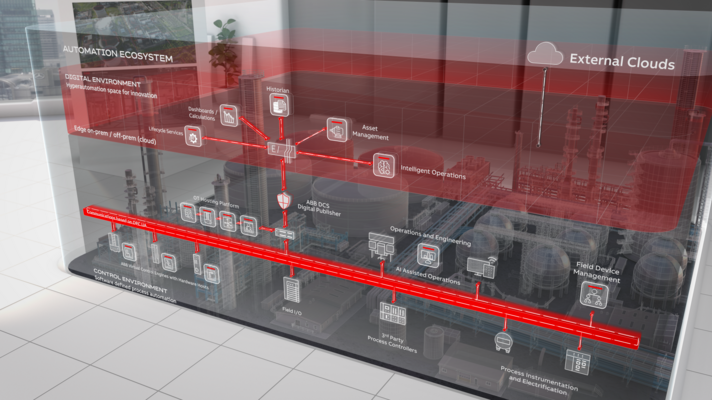
This is a principle applied in ABB’s Automation Extended. Having two interconnected software environments – core control and digital – establishes a true separation of concerns, while forming a single automation ecosystem. The control domain remains optimized for performance, resilience, and cybersecurity, while the digital domain provides a more flexible space to develop new innovations and concepts at speed. This simplifies complexity and creates an ecosystem in which operators can keep operations continuously optimized.
In the ABB system architecture, an application is divided into small, independent services, each responsible for a specific function. By isolating different concerns, changes in one part of the system are less likely to impact others, making each function easier to maintain and update without affecting the integrity of the core control. Functions can also be tested independently, making it easier to identify and fix issues before they risk compromising wider systems. Furthermore, functions that address specific concerns can be more easily duplicated or re-used elsewhere in the application.
By combining an OPC UA backbone with a cloud native, container based architecture, the system brings powerful new capabilities to industrial operations. This facilitates a broad spectrum of enhancements, from proactively detecting and correcting process anomalies to optimizing maintenance strategies through continuous condition monitoring of critical assets, while streamlining engineering with modular solutions that run across diverse hardware. The result is a scalable, agile architecture that maintains strong, reliable performance.
The digital environment allows new tools and applications including AI/ML, edge intelligence, IoT integration and advanced analytics to be introduced smoothly and incrementally at a pace that is in harmony with operators’ own business priorities and strategic objectives.
The Automation Extended architecture provides several benefits for end users. By separating different elements of an application, developers can focus on optimizing each individual part, leading to smoother and faster development workflows. Optimizing component parts separately, and fine-tuning each element for efficiency, can also lead to better plant performance overall. Issues in one module are less likely to affect the operation of other modules, meaning more stable operations generally, while security vulnerabilities can be more easily contained.
Innovation without disruption
Importantly, functional independence of this digital space from its neighbouring control environment preserves the integrity of core processes and proven control structures. Within this digital environment, new tools can be evaluated, deployed or updated at any time without putting the continuity of core control functions at risk.
For industrial operators this is a significant step forward. Modularity on its own is no longer enough. The next evolution in the DCS is intelligent separation. Automation Extended provides the framework for how future automation capabilities can be introduced progressively – preserving what already works while enabling the flexibility, scalability and efficiency needed for the next era of industrial operations. In essence, it helps automation systems to become smarter, faster, and more resilient – without disrupting what already works.
Luis Duran, author of this article:
Industry Initiatives, Standards and Market Trends Manager for Industrial Automation at ABB Automation. He has a BSEE and an MBA from the Universidad Simón Bolívar in Caracas, Venezuela, and has over 36 years' experience in various Process Automation roles, including Process Control, Manufacturing Execution Systems, Safety Instrumented Systems, and Critical Controls. He has over 22 years' experience in product management, including product marketing and product line management. He is ABB representative in the Open Process Automation Forum and participating in other industry initiatives such as Modular Automation and margo. He creates awareness of the ongoing challenges and changes experienced in industrial automation and the transformation of operational technologies to address the industry's future needs.