



PCN Europe: Bürkert is deeply involved in the topic of the 'regenerative economy'. How did Bürkert come to focus on this topic? Could you also briefly define the term for our readers?
Georg Stawowy: Perhaps we should start with the background. While developing our new Bürkert strategy, we realised that we wanted to prioritise sustainability, so we considered what needed to be done to achieve this. As part of the strategy, we then came to the conclusion that we needed to formulate a vision.
We believe it is important for a company to set itself overarching goals – a North Star that provides enduring direction. However, the more we researched sustainability, the more we realised that sustainability goals alone are insufficient. Focusing purely on sustainability activities means doing less harm than with the previous, conventional approach, but the clock is still ticking.
At some point, we came across the concept of regenerative economics. As we explored it further, we realised that regenerative economics is about changing the rules of the game. It's about rewarding different things and having a vision of how resources can be restored.
And if I had to define it, I would say that yes, a regenerative economy is the vision of considering, in everything I do, whether I can renew the resources I need. In simple terms, can I give back more than I take in order to improve the overall situation? At first glance, this sounds like a contradiction, especially for a private company. And of course, it is a major challenge when you start to think differently and say that it's not just about Scope 1 and 2 in terms of carbon footprint and photovoltaics. It's about how we can truly regenerate. What are resources anyway? Are we only talking about plastic and steel, or what other resources are there? And then I come to the topic of, well, employees are also resources, and I have to think about regeneration there too.
That's where we are right now, thinking about what that means in concrete terms in terms of implementation.
PCN Europe: That sounds unusual for a private company at first. But what does it mean for Bürkert? What measures need to be taken to move the company in this direction, but also to get its customers on board?
Georg Stawowy: Well, in my presentation, I showed the different levels at which action can and must be taken. The first key issue is responsible ownership: what do we do with the profits? This has already been regulated at Bürkert through the existing foundation structure, which is non-profit. And, of course, there is also the area of employees. What can I do for them to make them feel secure and appreciated in the company during difficult economic times? But, of course, the area of customers is central: what services do I offer and how must the company be positioned for this?
The first thing we did was to define four key areas from all the applications and customer groups we serve. Of course, we want to continue serving the other areas and also gain new ones, no question about it. These four focus areas are pharma and biotech, food and beverage, lab and analytical, and energy. What do they have in common? Put simply, they can contribute to creating a better world. Improvements in these areas can have an enormous leverage effect. We are also aligning the organisation of the company with these four sectors. The national subsidiaries have organised their sales departments accordingly, with internal and external sales forces. Behind this, we have business development, structured precisely according to the application and product managers, and behind that, development. It should be clearly recognisable everywhere what we stand for and what we offer.
If we can support our customers in improving their processes, for example in reducing CO2 emissions, we can achieve much more together than if our developers only improve our products, which of course they also do.
PCN Europe: Will this also have a positive financial impact?
Georg Stawowy: At present, perhaps one per cent of customers set this as a hard criterion. These are companies that say they will not buy from a supplier that does not invest in sustainability. However, for many buyers, sustainability does play a role, even if it is not defined as a hard criterion. And the number is sure to rise in both areas. It is a strategic risk for the moment, of course, but it will certainly pay off in the long term. Regenerative management is becoming part of our existing quality promise, because selling solely on the basis of the cheapest price is not an option for us.
The basic prerequisite is that I can demonstrate a positive effect and improve efficiency for the customer with my products; the rest comes on top of that. It is certain that the share of material costs in the bill of materials will increase. Therefore, it is sensible to address resource costs and efficiency as soon as possible.
PCN Europe: In the four areas mentioned, which applications does Bürkert specialise in? Through products or services?
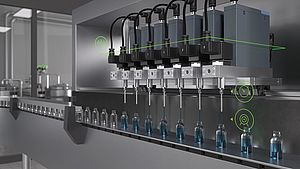
Georg Stawowy: Basically, a significant part of our business involves simply selling components, including in the aforementioned areas. Bürkert products can be found in a wide variety of applications in the pharmaceutical sector. However, we excel in certain applications, such as fermenters in the pharmaceutical and biotech sectors, as well as in the production of new foods, to mention just two examples. The same applies to microdosing, laboratory equipment, in vitro diagnostics, and working with small sample quantities. Our experience enables us to solve problems quickly. Another of our strengths when it comes to food and beverages is decentralised automation. This is not a component, of course. However, this control area for mixing processes – a classic example of which is the production of fruit yoghurt with various fruit preparations – is also important.
PCN Europe: What effect do you think the changes that have now been initiated will have on Bürkert's business model?
Georg Stawowy: Yes, it will certainly change the way we work with our partners if you think it through to its logical conclusion. We are moving away from a conventional business model and towards a circular and regenerative economy. If you go down that route, it will impact the business model. However, it also requires customers who are interested in developing and trying out new models. This starts with recycling, but also extends to overhauling parts for possible reuse. It also involves leasing or subscription models, right through to pay-per-use. This requires a great deal of flexibility.
For example, we could build systems for end customer orders and co-finance them through our products to enable us to scale up more quickly. But then a way to share the success must be found. As an example: If the system is installed at an end customer's site and the manufacturer receives a certain amount per litre of solvent, then a clearly defined share will also go to Bürkert. These are all things that are just getting started, but if you think regenerative management through to its logical conclusion, it's clear that completely different reward models are needed.
The final topic is our intention to prioritise service. This makes sense from an economic perspective. However, when discussing field service, it is important to clarify what is meant by this. For instance, we may receive an order from the beverage industry for plant maintenance.
This would mean carrying out maintenance on our own products and those of our competitors. This means that I also need to know the part numbers of the competitor’s spare parts. The technician must also have these available on site, such as valve parts, seals and diaphragms. A whole network of information and expertise needs to be built up, including ordering processes and item numbers. This is no trivial matter; it is comparable to the difference between authorised and independent car garages today – you need a broader knowledge base.
We have a lot of work ahead of us, but we are committed to this path, and it will change business models.
PCN Europe: Thank you very much for these insights. We look forward to following the developments.