


Automation has significantly improved safety, efficiency and productivity in the process industries, yet further performance gains are possible. Unplanned downtime still affects overall equipment effectiveness, with lost production and maintenance costs impacting profitability. While pumps, motors, fans and compressors are often viewed as the main risks, process automation and measurement instrumentation are equally critical.
Improving the reliability and long-term performance of field devices is therefore essential. These instruments often operate in harsh environments, facing extreme temperatures, pressure, corrosive materials, vibration and dust. Bulk solids applications are particularly challenging.
Challenges
Measuring solids is far more complex than measuring liquids. Unlike liquids, which form a flat surface, solids create uneven profiles, adhere to vessel walls, and change shape during filling and emptying. Ratholing can leave material along the walls, causing operators to overestimate available capacity and increasing the risk of overfills.
These conditions affect signal reflection and measurement accuracy. Reliable level measurement therefore requires technologies that can cope with uneven surfaces, unpredictable flow patterns, and low-dielectric materials that provide weak signal reflections.
Dust Generation
Significant amounts of dust can be generated during solids filling and discharge. In sufficient concentrations, airborne dust can present serious respiratory hazards and reduce visibility. Many dusts are also combustible; when combined with oxygen and an ignition source, dust clouds can lead to flash fires or explosions. Even minor overfills or uncontrolled discharge can increase dust concentrations, raising the likelihood of ignition from static electricity, hot surfaces or mechanical sparks. Dust and electrostatic charges can also affect level measurement accuracy and reliability. High dust concentrations may attenuate signals, create false echoes or lead to build-up on sensor surfaces. Over time, this can result in signal loss or inaccurate readings, making robust instrument selection critical.
Equipment Overload and Structural Stress
Solids can impose significant mechanical stress on vessels, handling equipment and instrumentation, increasing the risk of failure. Overfilling further exacerbates these forces, potentially overloading feeders, screw conveyors, rotary valves and discharge gates, highlighting the need for reliable and accurate level measurement. Material movement during filling and discharge can also place physical strain on contacting measurement devices, affecting their reliability and service life. For example, the probes of guided wave radar level transmitters may be subjected to bending, tensile or dragging forces as solids shift and settle, increasing the likelihood of damage or measurement degradation.
Benefits of Non-contacting Radar
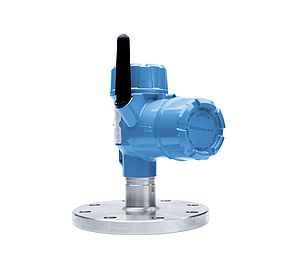
Non-contacting radar devices are well suited to a wide range of solids level measurement applications. They transmit electromagnetic signals that reflect from the material surface back to the antenna, enabling level measurement without physical contact. This makes them particularly effective in dusty environments and over long distances. Modern noncontacting radar transmitters based on frequency modulated continuous wave (FMCW) technology offer high accuracy and sensitivity, while requiring minimal wiring for power and communication.
Advanced signal processing allows these devices to ignore false echoes from internal obstructions, ensuring reliable measurements. They can also accommodate uneven and constantly changing surface profiles caused by phenomena such as bridging and ratholing. Specialised solids algorithms enable a representative average level to be calculated across a broader surface area, rather than relying on a single-point reading. For highly dusty environments, air purging systems can be used to prevent antenna build-up, maintaining signal strength and reducing maintenance requirements.
Minimised Maintenance Requirements
Modern non-contacting radar transmitters are designed for reliable, low-maintenance operation, helping to reduce downtime. Built to withstand shock, temperature extremes and outdoor exposure, they continue to perform in demanding environments such as silos, crushers and conveyors. Because the device does not come into contact with the material, there are no components exposed to wear, bending or damage from abrasive solids, heavy loads or vibration. This eliminates common failure modes associated with contacting technologies.
Coating and build-up are also less problematic, as the antenna is positioned above the process and can continue operating even in dirty conditions. As a result, the need for cleaning and maintenance shutdowns is significantly reduced. With no moving parts, these devices offer improved long-term reliability while keeping maintenance requirements and costs to a minimum.
Measuring the Level of Fly Ash
A good example of how non-contacting radar has eliminated downtime in a challenging solids level measurement application can be found at a waste-to-energy plant in Europe. Compressed fly ash produced from the incinerator is used as a construction material in road building. After chemical treatment, the ash is stored in three large (16 metres high) vessels ready for collection by trucks. The plant operator must continuously monitor ash levels to prevent overfilling, manage inventory, and schedule refilling, maintenance and cleaning when necessary.
Monitoring fly ash levels is difficult due to uneven surfaces, fast filling, and a highly dusty environment. The ash tends to stick to surfaces, creating build-up within the vessel and on instrumentation. The company had been using guided wave radar devices from another vendor, but ash accumulated on the probes, causing clogging after five or six days and leading to unreliable measurements. Weekly maintenance was required to clean the probes, exposing personnel to dust and taking vessels out of service for up to two hours. This interrupted operations and reduced overall process efficiency.
Emerson provided a replacement solution by installing a Rosemount™ 3408 Non-Contacting Radar Level Transmitter on each vessel. Key factors in the selection included ease of integration, fast commissioning and a strong return on investment. Although fly ash has a low dielectric constant, the FMCW technology used in the Rosemount 3408 maximises sensitivity to ensure accurate measurement. A smart solids algorithm enables reliable readings despite uneven material surfaces, while an advanced air purging system prevents antenna build-up. Signal quality diagnostics provide additional assurance by alerting operators to abnormal conditions or build up on the antenna.
The transmitters have delivered trouble-free operation, eliminating unplanned stoppages and improving both treatment and loading processes. Increased vessel availability has enabled more efficient truck loading, resulting in annual savings of approximately $80,000 and a return on investment in just one month.