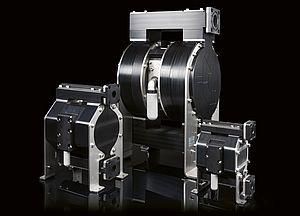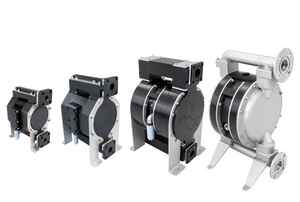

“Our aim was to specifically optimise the well-known system-related drawbacks of existing isolation chamber systems and thereby sustainably increase process reliability,” says Stefan Anstöter, Key Account Manager for chemical pumps at Timmer. Pneumatic double-diaphragm pumps are frequently used where other pump technologies reach their limits: with changing media, difficult pumping conditions or sensitive applications in the chemical industry.
Double-diaphragm pumps are subject to normal wear and tear resulting from operation. The diaphragm is the component that is subjected to the greatest stress. The barrier chamber was developed to enable the early detection of wear and to prevent any potential leakage of the fluid.
New design without a barrier fluid
Conventional barrier chamber systems operate using a neutral liquid between two diaphragms. This substance serves both to transmit force and to detect leaks. Anstöter explains: “The barrier agent must be precisely matched to the specific medium.” Depending on the medium being pumped, the conductivity of the neutral fluid must be taken into account and the sensor system individually calibrated. “This is labour-intensive and makes maintenance and servicing unnecessarily complicated,” says Anstöter.
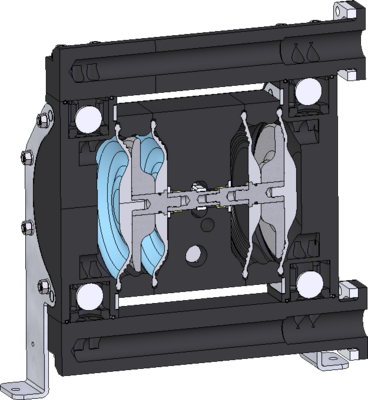
Timmer therefore takes a different approach: there is no liquid between the two diaphragms, but rather a dry barrier chamber. Force transmission is mechanical. Philipp Lange works as sales manager for process pumps at Timmer. He explains: “We use this mechanical principle in our high-pressure pump series, so we already had the solution in-house.”
Not only is the technical complexity reduced, but the new principle also increases the pump’s flexibility. Changing media or mobile applications can be implemented more easily because no adjustment to the barrier fluid is required.
Immediate leak detection
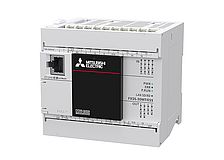
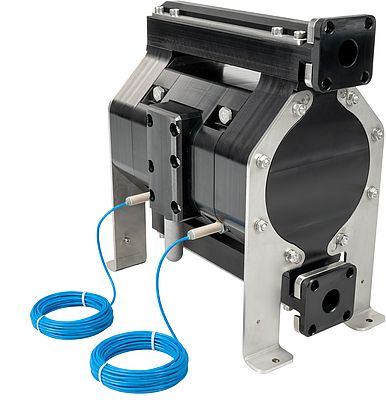
If the media-side diaphragm ruptures, the pumped medium first enters the barrier chamber. There, a moisture sensor identifies even the smallest quantities of liquid and can stop the process immediately. “Leak detection using moisture sensors is technically much simpler, as fluids in the barrier chamber are detected directly and no complex calibration or sensor adjustment to the monitored fluid is required,” explains Lange.
In addition, the pump can be fitted with a pressure sensor. It monitors the barrier chamber for pressure increases and detects if the air-side diaphragm is damaged and compressed air could enter the medium. Anstöter explains: “This not only protects the surrounding area from escaping media, but also prevents foreign substances from entering the process.”
This is an enormous advantage, particularly in sensitive applications. After all, it is not only leaking chemicals that pose a risk; even the tiniest impurities in the medium can render entire batches unusable.
Significantly less maintenance work
The new system also offers advantages in terms of servicing. As there is no barrier fluid, numerous upkeep and inspections steps are no longer required. “With conventional systems, the chambers have to be filled, vented and then precisely adjusted,” explains Anstöter. “With our system, servicing is essentially mechanical: clean, replace the diaphragms, reassemble, and you’re done.” This saves time and significantly reduces the workload, particularly in chemical parks where pumps are often maintained by in-house specialist staff.
Suitable for mobile applications and hazardous areas
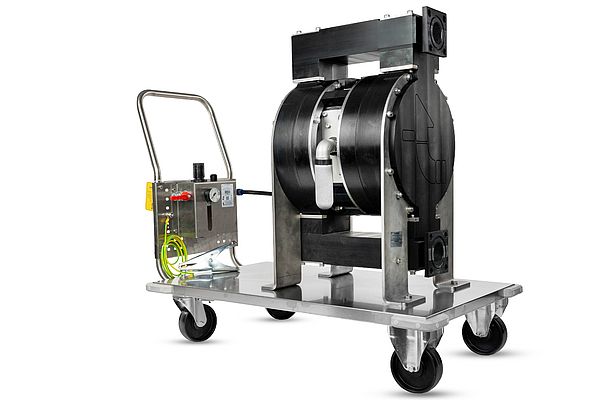
In addition to stationary applications, the pump is also suitable for mobile use. In chemical parks, pumps are often mounted on trolleys to flexibly transfer or pump different media. “Particularly with mobile applications, you often don’t know exactly which medium will be pumped next,” explains Anstöter. “In such cases, it is a major advantage not to have to adjust the barrier fluid.”
Timmer also offers mechanical versions without electronic sensors for this purpose. Lange says: “The system then operates entirely without additional electronics. The user can immediately see via the sight glass and/or pressure gauge whether everything is in order.” The mobile units are also designed for use in areas with potentially explosive atmospheres.
Already in use in the field
The first systems are now in operation at established chemical companies. For Timmer, this is an important step towards establishing the new concept in the demanding chemical industry. With the new barrier chamber system, Timmer demonstrates that high process reliability, simple maintenance and flexible application options can be combined without incurring additional technical operating and maintenance costs.