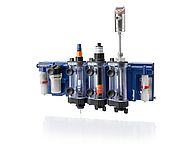




Liqueur pralines have a high-proof – as anyone who bites into them will immediately notice. Less obvious, but just as present, is alcohol in other products, although not necessarily for culinary reasons. For example, industrially produced baked goods often contain ethyl alcohol with 70 to 96 per cent by volume for preservation. The alcohol has an antimicrobial effect, inhibiting the growth of germs – and is therefore an integral part of the production process.
In addition to careful handling and hermetic packaging, preservation ensures that an elaborately manufactured product becomes safe for consumption – and does not pose a risk to consumers, for example through contamination. Unlike with some chocolate creations, however, the alcohol is not added to the products for preservation but rather applied to them. After baking, conveyor belts transport croissants or sponge cakes into a film tube. Spray nozzles located above the transport system spray the ethanol onto the dough products. Although the alcohol content in the sprayed baked goods varies, it is in a very low percentage range.
Tools instead of manual work
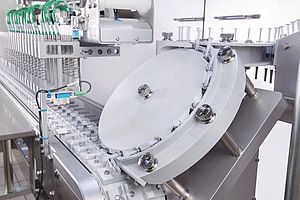
So much for product protection on the baked goods themselves. No matter how sophisticated the preservation technique, it would be pointless if subsequent processes couldn’t prevent contamination just as effectively. External factors are at the top of the list of things to avoid: particles and germs need to be minimised by manufacturers. But how? The answer to this challenging question is automation and cleaning. Where there is little human intervention in processes, the risk of contamination – for example, from particles entering the process – is dramatically reduced. Robots are therefore taking on transport and distribution tasks, especially within large packaging lines, where the sheer volume of products is too much for humans to handle.
Robots can perform these functions with great speed, lifting products from feed belts onto transport modules or into trays, for example. These agile helpers enable hygienic processes thanks to their easily accessible, easy-to-clean surfaces. There are also product-specific gripping or suction tools made from food-safe materials, which can now be easily manufactured using 3D printing. Unlike human hands, the devices always pick up baked goods with the same force and speed. In addition to the high level of process hygiene, robots also offer another clear advantage: intact waffles, biscuits and croissants that show no defects such as breakage or pressure marks – causing as little waste as possible.
In the eye of the scanner
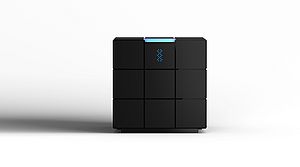
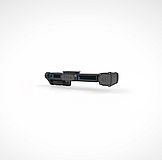
For this to succeed, another more inconspicuous technology monitors quality: several scanners check the products at different times, for example at the infeed and outfeed. The systems developed primarily by Schubert are located above the conveyor belts and resemble elongated lights under which the baked goods pass. Built-in cameras inspect every detail. Depending on the type, the scanners record different product characteristics that significantly influence product quality.
In addition to orientation, colour and shape – the main focus of 2D scanners - 3D variants also determine height, which is important for filled products such as biscuits. All parameters are specified in advance by the manufacturers. The scanners simply compare the baked goods on the conveyor belts with these specifications. Advanced systems such as those developed by Schubert can easily handle up to 5,000 units per minute. Should the values not match, faulty products are not picked up and fall into designated containers at the end of the belt. A broken biscuit or an unevenly shaped wafer never even makes it into the flowpacks or trays – and never reaches the shops.
Films for protection
Before opening, the packaging naturally has to form a perfect barrier. Flow-wrapped pouches support product safety: their barrier layer and seal effectively keep out unwanted foreign bodies. Depending on the type of film used, different layers provide the required barrier function: in composite films, for example, polyamide (PA) blocks UV rays and moisture while retaining the flavours of sensitive, fresh products.
When it comes to product protection, monofilms are in no way inferior to multi-material films. Single-layer films consist mainly of PP, which is both easy to heat and inexpensive, with low foreign substance content such as EVOH. The transparent plastic, which is applied in liquid form, creates a high oxygen barrier. Paper films also have a plastic layer that can be applied to the paper either as a water-soluble dispersion or, in the case of laminates, as a laminating film to promote sealing and barrier properties.
In addition to the film barrier, the seal itself fulfils a key protective function, as it hermetically seals the ends of the moulded plastic tube to the outside. However, not all film options can be sealed equally efficiently: composite films are made of more heat-resistant materials than PP monofilms with a low melting point. It is therefore important to adjust the temperature of the sealing tools for single-material films to prevent burning. Ultrasonic sealing provides a remedy here, as vibrations generate friction that gently heats the films. Alternative heat-sealing technologies are also available.
Customised sealing
Flowpackers from Schubert with box-motion ultrasonic sealing technology enable this. The technology is suitable for very high sealing requirements, for example for recyclable flowpacks made from monofilms and even for paper-based films. In contrast to rotary sealing systems, box-motion sealing tools move closed during sealing and synchronise with the film speed in its direction of travel. This ensures optimum sealing quality with hermetically sealed seams.
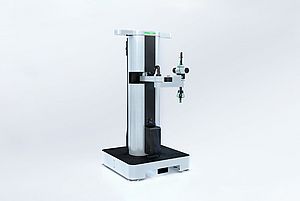
The result is improved tightness and sealing quality, especially with thicker or multi-layered materials. To ensure that the films deliver what they promise, leading manufacturers test them thoroughly in advance: Schubert uses various leak testing devices at its in-house technical centre to determine the position and presence of possible leaks and to rectify them if necessary.
Stability on the go
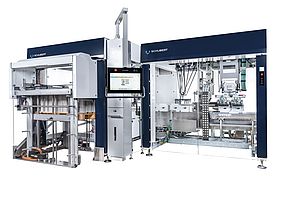
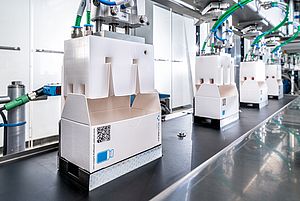
However, individual baked goods in flowpacks rarely reach the market without additional packaging. Trays and other outer packaging such as boxes help keep the often delicate creations stable – and therefore safe – during transport. Boxes minimise damage during transport. As mentioned above, robots assist with erecting, filling and closing suitable boxes. The agile machines are fully automated and ensure consistent quality of the transport and/or sales packaging.
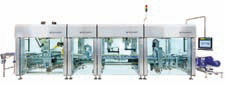
Here, too, product safety is paramount: cartoning machines from Schubert’s TLM series, for example, first erect blanks at a high cycle rate and glue them before multi-axis robots gently place the pre-packaged products into the cartons. Here too, precise movements and precisely calibrated tools are also used. Both processes – erecting and loading – are carried out separately to ensure that the baked goods are placed in their second packaging as quickly and safely as possible. From there, they are transported to the wholesale or retail shelves.
Shelf life, quality and safety are the result of the interaction of different systems. beyond the packaging, they ensure that baked goods reach consumers in perfect condition at all times. If one of the components is missing, product and consumer safety are at risk. This makes integrated concepts that combine technologies from a single source all the more important – for production that runs as smoothly as possible and meets the highest standards.