
When two aqueous liquids of different salt concentrations are separated by a semi-permeable membrane, a natural force causes the two liquids to mix. This natural force is called ‘osmotic pressure’. The liquid with the lower concentration attempts to pass through the membrane into the liquid with the higher concentration. This process generates a measurable pressure – osmotic pressure.
We are all familiar with this in practice. Ripe fruit tends to burst when it is hit by raindrops. The rainwater, which contains little salt, penetrates the fruit's skin (membrane) and enters the fruit itself, where the juice is more concentrated. This can cause the skin to burst.
In technical applications, the term 'reverse osmosis' (RO) describes the process of reversing osmosis by applying artificial counter-pressure using a pump. In this process, the saltier liquid (the feed) is forced against or through the membrane under high pressure. The membrane separates the permeate (water with a lower salt content) from the concentrate (residual liquid with a high salt content). Through a multi-stage process, the water can be desalinated to achieve ultra-pure quality. The classic membrane module is now designed as a wound spiral module. These modules must be replaced after a certain period of use. This creates a lucrative 'spare parts market', and water desalination using RO is a massive, highly competitive economic sector. However, the ongoing replacement costs and energy costs for the high-pressure pump make the process relatively expensive – but also very effective.
Technical RO is used wherever there is a need to produce purer, lower-salinity process water, drinking water or ultrapure water from existing saltwater sources. Systems today range from mini-plants for domestic or laboratory use, to skid-mounted solutions and mobile stations housed in shipping containers. Large plants with high desalination capacity are becoming increasingly common in areas where there is insufficient groundwater or fresh water. For instance, plants in the United Arab Emirates and India can supply entire neighbourhoods with fresh water. These plants are essentially huge factories. In arid regions, the substantial demand for electrical energy can often be met using solar power or existing natural energy sources, such as oil, gas, hydro power and wind power. A major problem is the large quantities of concentrate produced as a by-product of desalination. This brine cannot be put to practical use economically as it is too expensive compared to natural salt deposits.
In the case of mega-plants in coastal regions, seawater is drawn in from several hundred metres offshore and fed into the desalination plants. The concentrate is then flushed back into the sea via a separate pipeline at a different location. However, land-based plants often result in unsightly piles of dried salt concentrate, and the environmental impact of this has not yet been satisfactorily resolved.
The RO process is just one stage in the desalination of seawater to produce drinking water. Other pre-treatment stages in addition to conventional sand filters include ion exchange, coagulation and flocculation, sedimentation and disinfection. Nevertheless, RO is a highly effective filtration process, capable of removing 90–99% of dissolved solids, salts, pollutants and other impurities. It can even successfully filter out microorganisms, bacteria and viruses from the feed water.
A relatively new application of RO is the removal of PFAS (per- and polyfluoroalkyl substances), which are commonly known as 'forever chemicals'. These problematic substances do not break down naturally in the environment, so they are gradually accumulating in the world’s oceans and groundwater. They can be detected in humans and animals, and long-term exposure to high concentrations can pose a health risk. As these substances are found almost everywhere in our technologized world, a ban is in the pipeline, for example in the form of the EU's PFAS Regulation, and at a global level. However, the problem arises when there is no adequate substitute for the source materials (e.g. certain high-performance polymers, such as PTFE, which is used for the heat-resistant coating in frying pans). It is vital to not only prevent the presence of PFAS, but also to remove existing PFAS from drinking water and wastewater, to stop these substances reaching consumers. Reverse osmosis (RO) is successfully used here as a combined process with upstream activated carbon treatment or ion exchangers.
The world is facing water bankruptcy
Due to the effects of climate change, the world now consumes so much fresh water that it has entered an era of chronic water scarcity. Some regions are no longer able to recover from increasingly frequent water shortages, which are becoming more and more severe.
Around 4 billion people – almost half the world’s population – experience severe water scarcity for at least one month a year and do not have access to enough water to meet their needs. Many more people are experiencing the consequences of water scarcity, including dried-up reservoirs, sinking cities, crop failures, water rationing, and more frequent wildfires and dust storms in arid regions (source: UN).
This underscores the necessity to advance and enhance the performance of water and wastewater treatment processes. In addition to the reduction of water loss due to dilapidated infrastructure, affordable technical desalination solutions – and thus the production of clean water – are an important step forward. Such systems have long been proven effective, whether as a source of drinking water on large ships, as mobile units in disaster and war zones, or sometimes as the only source of water in remote regions of the world. There is a need for compact solutions and robust, tried-and-tested technology that can be easily maintained on site by local staff. To this end, the operational technology of such a system must be optimally coordinated.
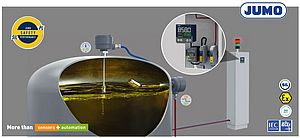
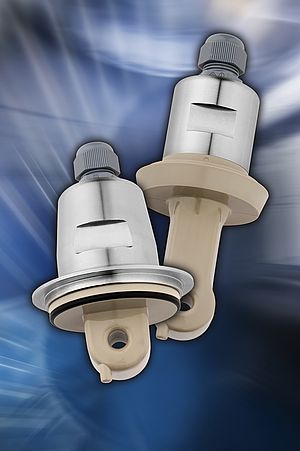
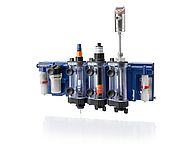
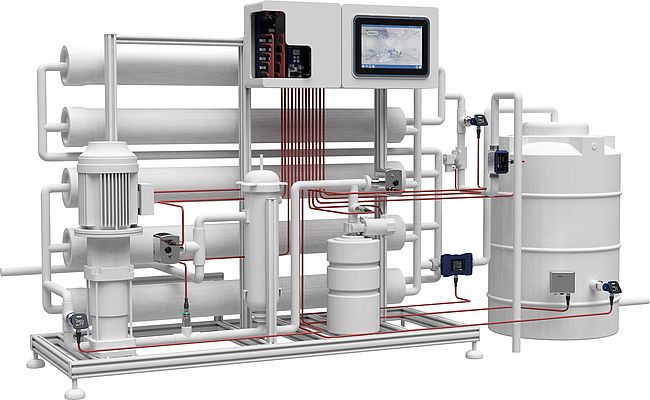
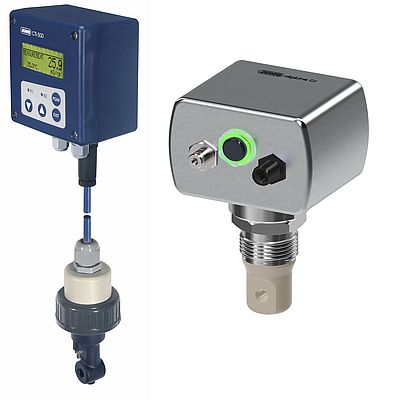
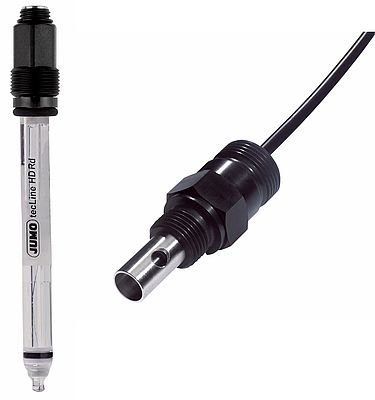
The key operating factors in an RO plant are water quality parameters such as pH, electrical conductivity (salinity), pressure, flow rate, and of course the level in the storage tanks. Chlorine or ozone measurements may be necessary for water disinfection, and the optical measurement factor NTU (Nephelometric Turbidity Unit) is also required for turbidity control. RO systems are built to meet water demand, ranging in size from small installations to mega-factories. This is why scalable technology that can be adapted to the required size is ideal. Not all measurements are required, nor are additional specialised measurements always necessary. For the inlet of raw water, inductive electrolytic conductivity measurement is now the standard. Thanks to the maintenance-free measurement principle, high readings and contamination are not a problem, whether the water is seawater, brackish water or general mains water. Depending on the source, readings of up to 100 mS/cm can be expected.
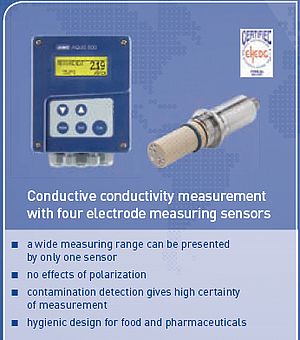
Following the initial filtration stages, the conductivity typically decreases to between 1 and 2 mS/cm, depending on the technology used. The target is to achieve a conductivity of between 200 and 500 µS/cm to ensure good drinking water quality. If even purer water is required for technical rinsing processes or for use as pharmaceutical-grade water, for example, further filtration stages must be incorporated. It is now possible to produce ultrapure Water for Injection (WFI) from seawater with a conductivity of 100 mS/cm, resulting in a final conductivity close to the intrinsic conductivity of water: approximately 0.05 µS/cm at 25 °C. Below 1 mS/cm, therefore, other measurement methods are used, such as the classic Kohlrausch cells for conductive conductivity measurement.
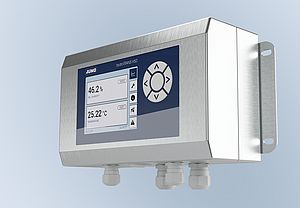
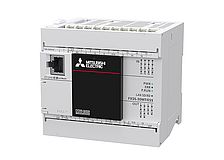
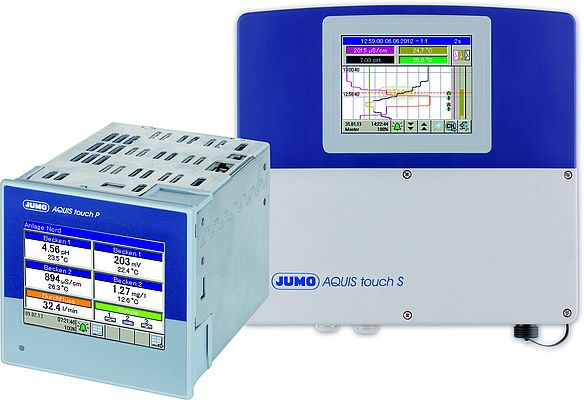
The conductivity measured in the series of connected filtration stages also serves as an indicator of the operational status and efficiency of the various filter and RO modules. Measuring values upstream and downstream of the individual stages enables the performance of the filters to be determined mathematically using a multi-channel data logger such as the JUMO AQUIS touch, or a PLC (e.g. the JUMO variTRON).
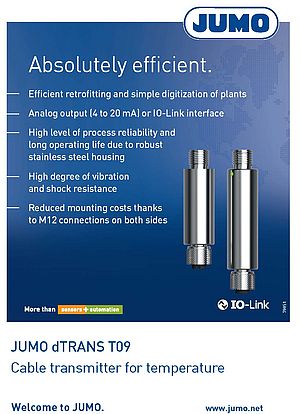
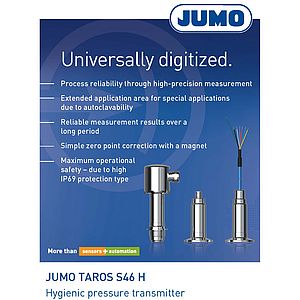
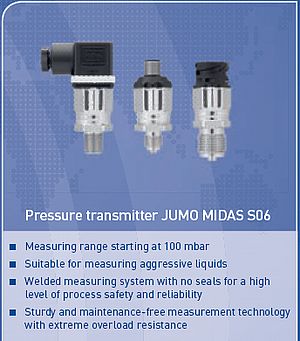
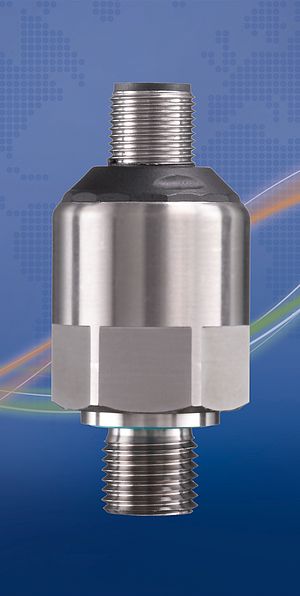
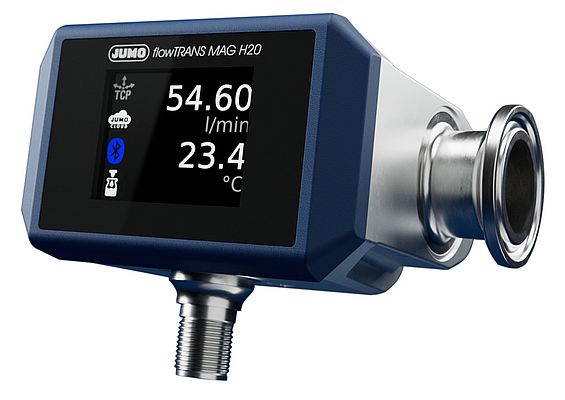
Pressure and flow measurements monitor pump performance as well as the condition of the filters. RO systems operate at pressures of around 100 bar, so reliable measurements are essential to ensure that the electrical energy for the pumps is used optimally. In drinking water applications, devices using magnetic-inductive or ultrasonic measurement methods can be used.
For manufacturers of such systems, a one-stop partner is ideal. All measurement and control components are perfectly coordinated, and all consultancy services are provided by a reliable project partner. JUMO is the ideal choice here, thanks to its many years of expertise, its broad product portfolio, and its global presence. In addition to traditional products, services such as pre- and after-sales support and engineering services perfectly complement the offering. The JUMO Cloud solution is ideal for the remote monitoring of decentralised water treatment plants. Remote control, measurement data logging, and remote alarms help to keep water quality under constant surveillance and provide on-site operators with rapid support when needed.