As digital transformation increases demand for data from automation systems – driven by new digital innovations such as advanced analytics, AI and expanded connectivity – maintaining system integrity has become a challenge. ABB’s Luis Duran explores how the concept of “separation of concerns” protect the core of the automation system in a cyber-secure way, while enabling new digital value without compromising operational performance.
The fertilizer sector is caught in a global paradox between growing food to feed billions and the urgent need to decarbonise. Compressors present a largely overlooked opportunity to reduce lifecycle costs and carbon emissions, while enabling more sustainable production of ammonia. Author: Greg Gedney, Business Development Manager, Industrial Operations, Greene Tweed
ELGi Compressors Europe, a subsidiary of ELGi Equipments Limited announced the transformative operational results achieved by its customer, Guttsta Källa AB, a century-old Swedish natural mineral water producer. By implementing a high-performance ELGi compressed air solution, Guttsta Källa has dramatically increased its production throughput while delivering substantial annual energy savings of 120,000 kWh, positioning the company for continued growth in the premium Swedish bottled water market.
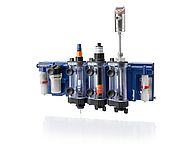
Inline Ultrasonic Concentration Measurement and Bubble Detection System
At the Bürkert Trade Press Days we spoke with Georg Stawowy, CEO of Bürkert Fluid Control Systems about the concept of a regenerative economy.
Valuable energy is lost in pressure reduction stations, exhaust steam pipes and condensation systems. With Energify system, the company CFT GmbH offers a simple and robust solution for the cost-effective conversion of even slight pressure differences into energy. This saves electricity costs and lowers CO₂ emissions. The system performance is controlled precisely with sliding gate valves from Schubert & Salzer.
Looks matter, but they aren’t everything: long before croissants, biscuits or waffles are placed in protective packaging, manufacturers need to ensure that their contents are exactly as they should be. In upstream steps, producers pave the way for the highest quality, safety and shelf life of ready-to-eat products. Ingenious technologies that work towards this goal are always part of the packaging process.
Gentle, energy-efficient handling of bulk materials
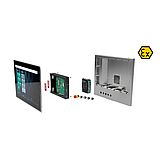
For reliable detection of pressurized gas leaks, mechanical faults, and partial discharge in explosive vapor and dust environments
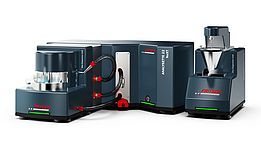
Precise material analysis plays a central role in many industries - from the pharmaceutical and food industries to construction materials, biotechnology and environmental sciences. Whether for quality assurance or for predicting material behaviour, the precise characterisation of particles is crucial.
From fertilizer to energy source of the future
To help engineers and operators meet the challenges of precision batching and ensure accurate measurements and smooth process operations, the editorial shares some key insights.
Camera-only variant via kiosk mode available
Fraunhofer researchers have developed sensor systems and measuring equipment that detect leaks in hydrogen lines and tanks. Applications for the new technology include continuous monitoring of hydrogen shipments and facilities in the chemical industry.
Additional 4,000 square meters of production and warehouse facilites for efficient manufacturing processes
International Federation of Robotics reports on trends in the industry
Multilingual and Open Source: OpenGPT-X research project releases large language model
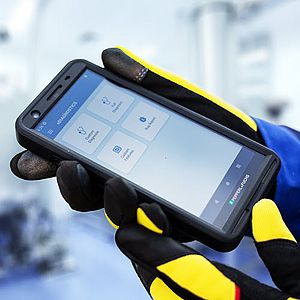
Intrinsically safe phone for digital workflows in hazardous environments
Versatile and robust design to meet the needs of field workers
Distributor converts Caustic Soda to 100% Green Caustic starting in the Netherlands and Belgium
Plasma-coated paper as a plastic alternative for the packaging industry
Wireless sensors for condition monitoring prevent unplanned downtime of critical centrifugal pump
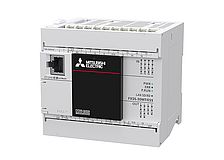
Mitsubishi Electric technologies have enabled the development of innovative composting machines that can turn food waste into high-quality fertiliser in just 24 hours. This solution responds to the global problem of waste, in particular food waste, which constitutes about 30% of landfill waste. For Radisson Blu Scandinavia, this technology enables the daily processing of food waste from restaurants, room service, and other food-related operations.
Process industries, with a focus on Chemicals plants, are currently experiencing an evolution. Plant operators are grappling with a market that is shifting towards shorter product lifecycles, regularly changing feedstocks, an overall more precise yet rapid approach to production and narrowing profit margins.
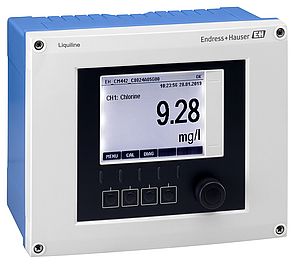
The German sensor company and the Swiss measurement and automation technology specialist have agreed on a strategic partnership. Endress+Hauser will take over worldwide sales and service of SICK’s process analyzers and gas flowmeters, with a joint venture to be established for their production and further development.
Cleaning systems of industrial large filter systems are often poorly regulated and therefore consume large amounts of expensive compressed air. That´s over now: A new feature of the solenoid valve controller HE 5750 of AXXERON HESCH electronics, allows for an exact setting of the cleaning pressure. We asked the Managing Director, Werner Brandis: How does pre-pressure control work exactly and what are further advantages for the industry?
Steen-Hansen – a Norwegian manufacturer of fouling prevention and net protecting solutions for aquaculture use as well as of specialized industrial paint systems – has not only successfully overcome quality problems with its newly developed antifouling coatings, but also significantly shortened process times, simply by switching its production facilities to state-of-the-art mixing and dispersion technology.
The measurement of low flow is becoming widely used in many industries. However, the smaller the flow, the trickier it is to control and measure, and finding a suitable flow measuring technology at reasonable cost can prove challenging for both users and flow sensor manufacturers.
Absolute sterility, optimised processes and lower operating costs – the food industry is challenged to align its production procedures amid these conflicting interests. The measurement technology employed to check individual process parameters plays a decisive role here. WIKA has now opened up a new chapter in pressure instrumentation: an in-line process transmitter with a “dry” measuring cell takes monitoring of this variable in sterile applications to a higher level.
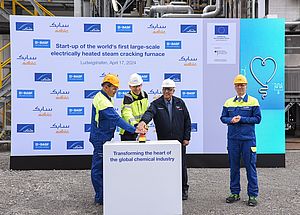
Joint development and construction of electric steam cracking furnaces at BASF’s Verbund site in Ludwigshafen. The technology has the potential to reduce CO2 emissions by at least 90% compared to conventional steam crackers.
Easy discharge and cleaning without bomb doors or manual intervention
Ethernet APL is a game changer for networking at field level – especially for the process industry. It offers consistent networking with a single protocol, high speeds for cable lengths of up to 1000 metres and intrinsic safety for areas at risk of explosion.
Today, the majority of consumer goods and everyday items are made from petroleum-based plastics. In Germany alone, around six million tonnes of plastic waste is generated every year. About half of this is mechanically recycled into new materials; the rest is used for energy recovery. The incineration of this waste results in the release of CO2, a greenhouse gas. It is therefore important to keep more plastics in the material cycle for climate and environmental reasons. Eight Fraunhofer Institutes are developing new ideas and processes to significantly improve the mechanical recycling rate of plastics as part of the Waste4Future flagship project.
Optimization of offshore wind turbines and onshore facilities for Japan’s largest wind farm
Water management is an increasingly important and challenging issue, particularly in light of concerns such as water scarcity. Greater value is thus being placed on disinfection processes. To protect against bacteria, viruses and other harmful organisms, drinking water requires disinfection and hygiene measures. This also applies to the environment in order that lakes and water-based activities can be enjoyed without hesitation. Disinfection processes play a large role in industrial processes as well. In the beverage industry, drinking water flows directly into the products, while surface waters are frequently used as a coolant in other segments such as energy generation.
6-inch device combines European inhouse expertise
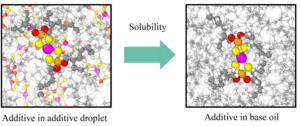
Mechanical bearings and gearboxes — like those used in electric vehicles and wind farms — are often treated with lubricants to avoid friction and wear. The voltage the components might be under impairs the effectiveness of the lubricants to such a degree that the tribological contacts are damaged. As part of the Lube.Life joint research project, researchers at the Fraunhofer Institute for Mechanics of Materials IWM have developed a virtual lubricant lab, which can be used to predict the effects of electrical fields on lubricant stability.
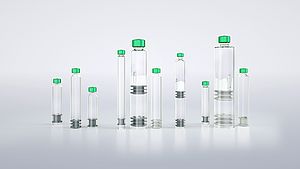
What does an ambitious contract manufacturer need when customers wish to expand their orders? Exactly, new equipment! The Malmö-based Swedish company Rechon has been a reliable partner to many pharmaceutical producers for decades, from clinical trials through to commercial production. The current trend towards cartridge filling is a good reason for Rechon to continue the successful relationship with Syntegon.
Valmet entered into an agreement on July 14, 2023, to acquire the Process Gas Chromatography business of Siemens AG. The value of the acquisition is EUR 102.5 million on a cash and debt-free basis subject to customary adjustments.
Investment of €1 billion in Germany, €500 million for new Technology Campus in Erlangen to create blueprint for industrial metaverse in Nuremberg metropolitan region
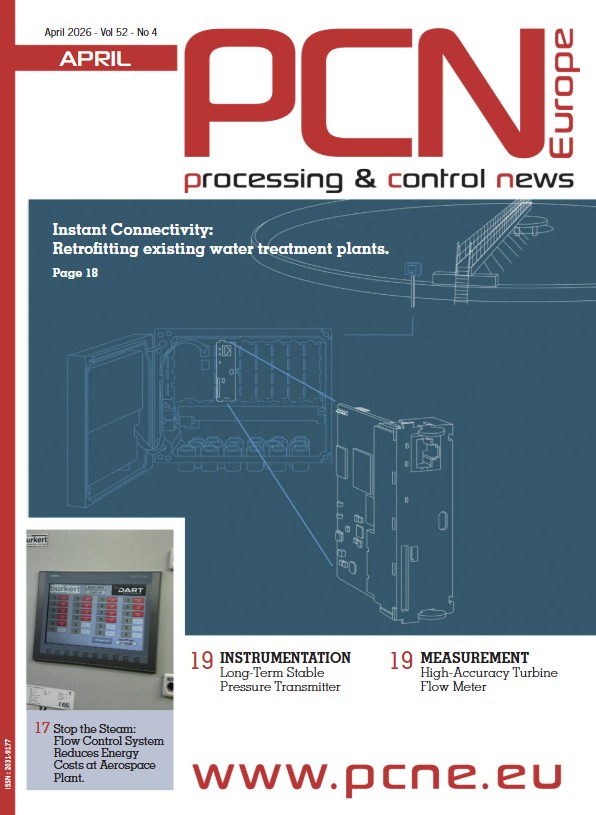
Digital Edition Download PDF