
High-temperature electrolysis is a highly efficient process for manufacturing hydrogen that involves splitting water vapor into hydrogen and oxygen in an electrolysis cell. The main advantage: The elevated temperatures enable industrial waste heat to be used as the direct energy source for the reaction. This reduces the consumption of expensive electricity, accelerates the electrochemical reactions and significantly improves overall efficiency.
A new scientific and methodological approach by Fraunhofer IKTS
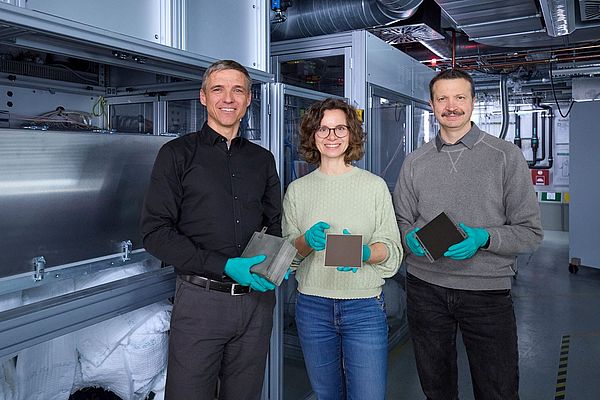
Researchers at Fraunhofer IKTS have spent more than two decades pursuing an extremely ambitious goal: to make high-temperature fuel cells and electrolyzers so powerful, robust and cost-effective that they not only support the energy transition but could significantly accelerate it. “Our goal right from the start was to build a bridge between electrons and molecules,” says Mihails Kusnezoff, Department Head for Materials and Components and Head of Energy at Fraunhofer IKTS. The Fraunhofer IKTS team’s approach differs significantly from that of many competitors: Instead of developing separate concepts for electrolyzers and fuel cells, the researchers have created a system that can operate in both modes. This was a major challenge, as Kusnezoff explains: “While fuel cell operation requires low resistance and high voltages, electrolysis demands long-term stability and practically thermoneutral operation with minimal temperature gradients.”
A versatile stack suited to mass production
In the lab, the researchers developed new electrolyte and electrode materials and optimized microstructures in order to build high-performance cells. “It’s only by combining multiple cells that we get what is known as a stack. This is the heart of the system and facilitates the scaling necessary to produce hydrogen in industrial quantities,” explains Sindy Mosch, researcher and member of the Materials for Printed Systems working group at Fraunhofer IKTS. The technical breakthrough was ultimately achieved by a combination of material innovation, design optimization and a consistent focus on industrialization. “We had to learn to think of electrochemical, thermal and mechanical effects as an integrated system. It was only by precisely coordinating microstructure, sintering behavior and protective layers that we were able to develop a cell that can function reliably for years both under the demanding conditions of electrolysis and in fuel cell mode,” says Sindy Mosch.
The Fraunhofer IKTS stack works reliably within an extended temperature range of 750°C to 850°C – a factor that plays a critical role in the lifespan of an electrolyzer. Within this temperature range, it is possible not only to convert water vapor and CO₂ into synthesis gas by means of electrolysis but also to use a variety of fuels such as natural gas, biogas, methanol, ethanol and even green ammonia in fuel cell mode for power generation.
From lab to factory: pilot production in Arnstadt
At the same time, the team addressed the issue of industrial scale-up by redesigning the metallic bipolar plate so that it can be efficiently manufactured in a single pressing operation, besides developing scalable coating processes for electrodes and contact/protective layers. “For us, one thing was clear: Technology can only contribute to the energy transition if it functions in the factory and not just in the lab,” emphasizes Stefan Megel, Ceramic Energy Converters Group Manager at Fraunhofer IKTS.
The technology’s industrial readiness has also impressed industry players: thyssenkrupp nucera identified the newly developed stack as an especially efficient and promising solution in the field of high-temperature electrolysis. Within just 14 months, Fraunhofer IKTS established a partially automated pilot production line at its Arnstadt location, thus laying the foundations for further scale-up together with its industry partner thyssenkrupp nucera. “The pilot phase has shown that our stacks combine scientific excellence with scalable, cost-effective production all the way up to gigawatt level,” says Stefan Megel.
Key technology for industrial decarbonization
Stack development at Fraunhofer IKTS has not only set new standards of efficiency and technological versatility but is also paving the way for the industrial use of electricity and waste heat for highly efficient hydrogen and synthesis gas production. The Fraunhofer IKTS team is thus contributing directly to the global energy transition while strengthening Germany’s competitiveness as an industrial location.