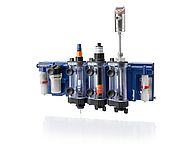



PFAS Resolve integrates selective PFAS concentration using VAL Foam Fractionation (VFF) technology from Coldep with electrochemical oxidation (EOx) powered by Axine Water Technologies’ electraCLEAR™ platform. Together, these complementary technologies enable a complete treatment solution that can achieve high levels of PFAS destruction, while supporting closure of the PFAS water loop.
PFAS contamination remains one of the most complex challenges in water treatment today. While many conventional technologies successfully remove PFAS from water, they typically transfer the problem to secondary waste streams such as spent activated carbon, ion exchange resins or concentrations that require off-site disposal or incineration. PFAS Resolve takes a fundamentally different approach by enabling on-site concentration and destruction.
“PFAS Resolve is designed to not only remove PFAS from water, but to permanently destroy it,” says Yannick Severin, Global i-CONSULT manager - Nijhuis Saur Industries. “By combining efficient concentration with on-site destruction, we avoid long-term liabilities, transport risks and dependency on scarce incineration capacity.”
From removal to true PFAS destruction
At the core of PFAS Resolve lies the combination of complementary technologies:
- 1- VAL Foam Fractionation (VFF)
Developed by Coldep (part of NSI), selectively concentrates mid- and long-chain PFAS by exploiting their surface-active properties. The technology operates with low energy demand and minimal chemical consumption, producing a highly concentrated PFAS stream. It can process any type of water, such as groundwater, (industrial)wastewater, RO-concentrates, ion exchange regenerates etc.
“Vacuum foam fractionation transforms PFAS treatment from a removal step into a true concentration solution,” explains Sébastien Latz, CEO of Coldep, part of NSI. By generating very high bubble surface area under vacuum and producing very dry foam, we achieve orders-of-magnitude volume reduction with lower air demand and footprint than conventional systems. This makes downstream PFAS destruction significantly more practical and cost-effective” - 2- Electrochemical Oxidation (EOx)
Powered by Axine’s electraCLEAR™ technology, EOx destroys PFAS at the molecular level under ambient conditions without generating secondary solid or liquid waste streams. The process enables efficient and reliable destruction of even short- and ultra-short-chain PFAS compounds that are traditionally difficult to treat.
“ElectraCLEAR™ is built for complex streams containing PFAS, active pharmaceutical ingredients, and other persistent organics that conventional and AOP-based treatments often struggle to fully destroy. Our advanced catalyst materials enable direct and indirect oxidation pathways, delivering efficient destruction across long-, short-, and ultra-short-chain PFAS. Backed by our experience across hundreds of waste streams and proven commercial operation since 2017, we partner with customers to optimize the full treatment approach—ensuring reliable performance, economic viability, and long-term compliance in an evolving regulatory landscape. Our systems are modular and highly automated, designed to scale with changing wastewater conditions and evolving treatment objectives, providing a flexible, future-ready solution.” Andrew Mrasek, Chief Revenue Officer at Axine Water Technologies - 3- Smart Polishing
Where required, polishing technologies such as regenerable ion exchange, granular activated carbon (GAC) or reverse osmosis (RO) can be integrated to meet more stringent discharge or reuse targets. Concentrations generated during polishing can be recirculated into the VFF-EOx treatment train, further supporting closed-loop PFAS management.
Together, these building blocks enable economical on-site PFAS destruction once sufficient concentration is achieved, representing a key differentiator compared with standalone destruction technologies.
A game-changing and viable alternative to incineration
PFAS Resolve provides a compelling alternative to traditional off-site incineration routes, which are increasingly constrained by limited capacity, logistical complexity, regulatory uncertainty and volatile operating costs. By enabling localized treatment and dramatically reducing concentrate volumes, PFAS Resolve delivers significantly lower lifecycle costs per ton of PFAS concentrate while improving operational resilience.
The modular design allows the solution to be tailored to different water matrices, including groundwater, industrial wastewater, landfill leachate and RO concentrates and deployed as either permanent installations or mobile treatment systems.
Supported by consultancy and pilot testing
PFAS Resolve is backed by NSI’s Lifecycle Services and i-CONSULT capabilities, covering technology selection, bench-scale validation, pilot testing and full-scale implementation.
Several industrial clients are currently testing PFAS Resolve technologies under real operating conditions as part of structured decision-making programs toward full-scale deployment. Existing full-scale references span sectors including waste management, chemicals and semiconductors.
“PFAS challenges are highly site-specific,” adds Yannick Severin. “Our role is to combine technology, data, operational and regulatory insight to deliver solutions that are technically robust, economically viable and future-proof.”