


Process industries are undergoing a fundamental transformation toward autonomous production systems. These promise not only greater efficiency and sustainability but also the ability to adapt dynamically to changing conditions. The path forward involves integrating intelligent control technologies and orchestrating complex systems across the entire plant lifecycle.
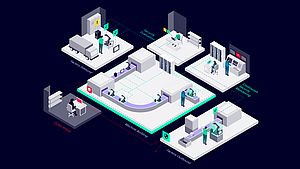
A fully autonomous process plant seamlessly integrates four core areas into a self-regulating system:
- Logistics: Algorithms predict material requirements and autonomously optimize supply chains.
- Production: Processes continuously adapt to raw material qualities, product specifications, and energy prices, orchestrating hundreds of interacting variables without human intervention.
- Maintenance: Systems detect wear early and dynamically adjust maintenance intervals to plant conditions.
- Optimization: Data-driven and model-based methods continuously improve energy and cost efficiency, yield, and product quality.
These four areas must not only function individually but work together in orchestrated harmony. However, before this overall orchestration becomes possible, powerful technologies are needed for each field of action. For the fields of production and optimization, Advanced Process Control (APC) has established itself as a key technology. APC forms the technical backbone of autonomous process operation by combining process control with continuous operational optimization, going significantly beyond conventional control systems. APC integrates various technology domains, particularly model predictive control (MPC).
Three core applications of APC
APC pursues three central optimization objectives: increasing throughput at bottlenecks, reducing energy and resource consumption, and stabilizing product quality. At bottlenecks, such as distillation columns, furnaces, or compressors, APC continuously maintains critical parameters at their optimal limits, a principle known as "kissing constraints". This enables capacity increases or cost reductions of typically up to ten percent without additional hardware. In energy optimization, APC minimizes the consumption of fuels, for example, through continuous adjustment. Quality stabilization is achieved through virtual sensors that estimate and control product properties in real time. This can reduce plant off-spec production by 20 to 70 percent while optimizing product transitions.
Technologically, APC combines the areas of modeling, artificial intelligence, optimization, and control: Process models (grey-box, white-box, or black-box) are trained and embedded in real-time optimization algorithms. Model predictive control (MPC) calculates future process behavior in advance and adjusts manipulated variables preventively, ensuring optimal operation of the production process. This is particularly valuable for long dead times (typical in thermal processes), pronounced nonlinear behavior (such as in chemical reactions), and strong coupling between process variables, or multivariable systems – scenarios where traditional PID controllers reach their limits. This is complemented by procedural automation, which makes complex sequences such as startup, shutdown, or product changeovers systematic and reproducible. What once relied on the experiential knowledge of individual operators is now standardized, transparent, and robust.
From theory to practice: a modular approach
The practical implementation of APC requires different methods for different process characteristics. For continuously operated processes with moderate nonlinearities, linear model predictive methods have proven effective. More complex scenarios, such as batch processes in the pharmaceutical industry or highly nonlinear reactions in polymer chemistry, require nonlinear methods that utilize detailed process models. Recent developments with models based on artificial intelligence work more data-efficiently than classical machine learning approaches and are capable of optimizing and controlling highly nonlinear systems. This can be complemented by soft sensors, anomaly detection, and planning modules for site-wide optimization. SIMATIC APC, Siemens' APC suite, illustrates this holistic approach: modularly designed, vertically integrable from field level to enterprise planning, scalable from individual controllers to site-wide optimization. SIMATIC APC covers the entire APC workflow, from PID tuning through system configuration to autonomous operation and closed-loop AI, offering comprehensive solutions for all process control requirements and APC technologies, including SIMATIC APC Services. Production processes can thus be continuously improved step by step.
Measurable value in practice
The optimization of spray dryers for infant formula at Siemens customer Danone exemplifies the value of SIMATIC APC: Siemens deployed a physics-based digital twin as a soft sensor that continuously monitors product moisture content and performs real-time optimization. The results: Product moisture content increased by five percent, variability decreased by 30 percent, with a return on investment of less than six months. This example demonstrates how APC simultaneously improves product quality, resource and cost efficiency, and economic viability through precise process control. The soft sensor can replace costly laboratory analyses with continuous online monitoring and real-time models, enabling the system to calculate process parameters such as air temperature and throughput that are not measurable in real time or are too expensive to measure. Yet despite such successes, a limitation also becomes apparent: Various systems such as APC and soft sensors work hand in hand. Experienced engineers must orchestrate these systems, interpret data from different sources, and make decisions.
From process excellence to plant orchestration
The challenge in realizing autonomous process operations often lies not in the performance of individual systems but in their orchestration across different systems. Each field of action, from logistics to optimization, has developed its own IT systems, data models, time scales, and workflows. APC operates on time scales from seconds to hours, maintenance planning in weeks, material ordering in days. Data models are incompatible, interfaces are manual. Each plant is individually configured, documented, and maintained – a process that can take months and tie up considerable resources.
In the process industry of the future, agentic systems address this challenge: Specialized software agents take on defined tasks such as operational optimization, material planning, and maintenance coordination, and communicate with each other like a team of experienced specialists. The crucial difference: Agents combine decentralized intelligence with centralized coordination. Changes are not made in isolation but evaluated in the context of the overall plant.
Agentic systems are scalable and adaptive, as they learn from data and adjust their behavior to changing conditions. An agent for energy optimization could, for example, learn to anticipate volatile electricity prices and adjust production plans accordingly. Additionally, agents negotiate solutions for conflicting objectives: If production demands maximum throughput but maintenance plans an inspection, the agents find a compromise, such as a brief inspection during an already planned product changeover.
The technical foundation of these agents is industrial-grade artificial intelligence – AI systems specifically developed for the requirements of the process industry. Unlike generic AI models, these systems take into account physical laws, safety requirements, and regulatory specifications. They are transparent in their decisions, robust against incomplete data, and certifiable for safety-critical applications.
Integration across lifecycle and hierarchy
Connecting agents into a coordinated network enables seamless integration across the entire plant lifecycle – from design and planning through engineering and operation to maintenance and modernization. Today, each phase has its own tools with manual data exchange: CAD systems for design, engineering tools for configuration, control systems for operation, maintenance management systems for upkeep, and APC systems for operational optimization and control. Changes in operation are not automatically transferred to engineering documentation. Agentic systems break down these silos: A digital twin serves as a common data foundation that agents continuously update. When a maintenance agent replaces a pump, the optimization agent automatically recognizes the new performance parameters and adapts its models.
The situation is similar with vertical integration across hierarchical levels: from individual sensors through process units to sites and enterprise level. Industrial copilots (AI assistants for operators and engineers) consolidate complex data volumes and make them accessible across levels. In the future, autonomous AI agents will build workflow-oriented networks modeled on the working methods of human teams. The result: a fully integrated lifecycle with consistent data and coordinated decisions.
Outlook: the synergy of APC and agentic systems
The combination of Advanced Process Control as the technical foundation for process control and optimization with agentic orchestration systems creates the basis for the next generation of autonomous process plants. While APC delivers excellence in process operation, agents enable orchestration across process boundaries. This synergy can elevate traditional performance metrics to a new level in the future: Profitability increases through better resource utilization and reduced downtime, product quality becomes more stable through coordinated control across the entire value chain. Systematic energy optimization and emissions reduction improve sustainability, while faster product changeovers and more flexible production planning shorten time-to-market.